
FinanceSeva.com · Structured Finance Case Study · India
STRUCTURED FINANCE · INDUSTRIAL ACQUISITION · SHARE TRANSFER
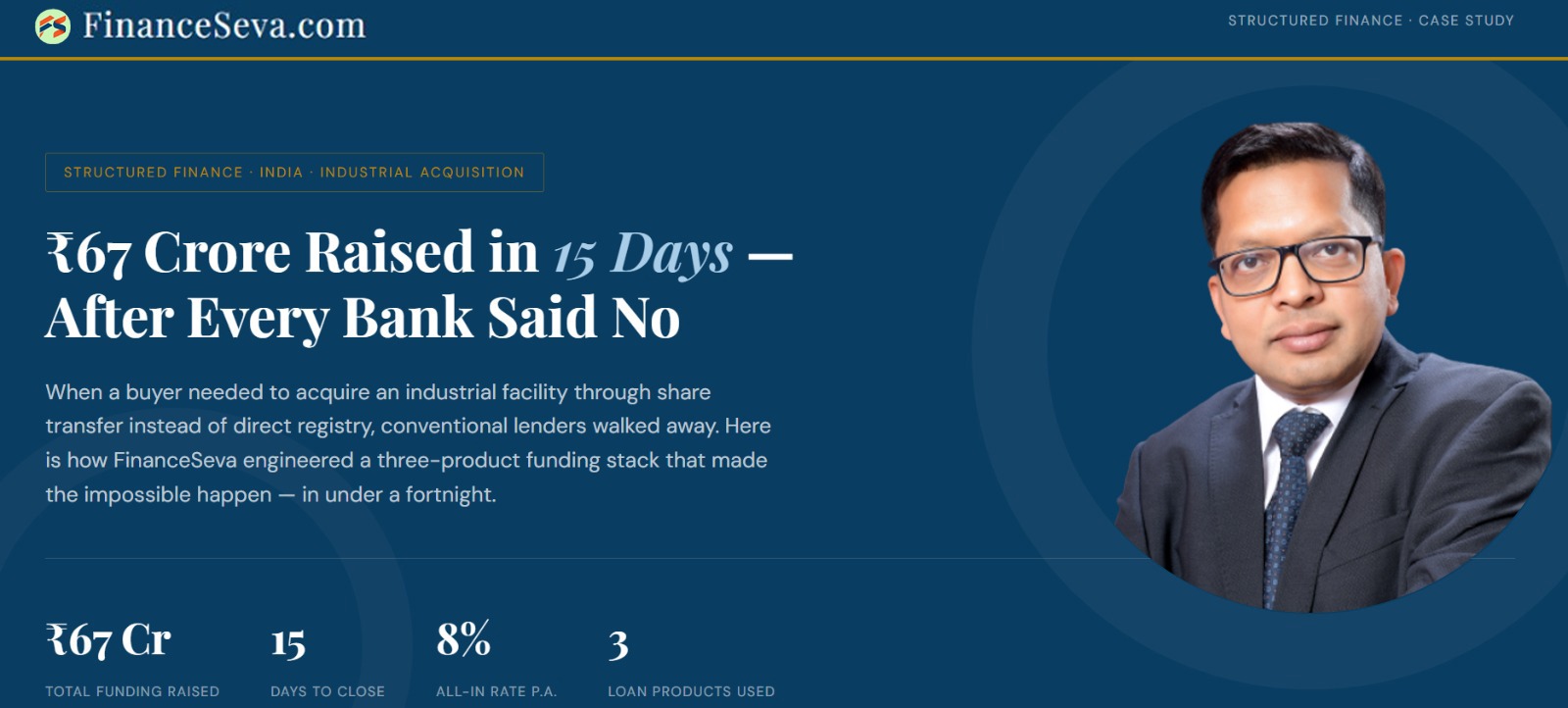
?67 Crore Raised in 15 Days — After Every Bank Said No
When a buyer needed to acquire an industrial facility through share transfer and every mainstream lender walked away, FinanceSeva engineered a three-product funding stack that made the impossible happen — in under a fortnight.
DEAL AT A GLANCE
?67 Cr TOTAL FUNDING | 15 DAYS TO CLOSE | 8% p.a. ALL-IN RATE | 3 LOAN PRODUCTS |
THE PROBLEM
To understand the solution, one must first understand why the problem existed at all. In India, banks and NBFCs can lend against property — but lending to acquire shares in a company that owns property is an entirely different matter, governed by separate regulations and subject to much higher scrutiny.
The structural constraints
What the deal had going for it
| The core insight: The problem was not creditworthiness — it was framing. Every bank had looked at the deal and seen “share purchase finance.” FinanceSeva looked at the same transaction and saw three separate, legitimate loans, each with its own collateral and cash-flow logic. That reframing changed everything. |
THE SOLUTION
The FinanceSeva team designed a funding structure with a single governing principle: every loan must stand entirely on its own commercial logic. None of the three facilities could be described as ‘share acquisition finance.’ Each had to be defensible on its own terms — its own collateral, its own repayment source, its own regulatory standing.
Together, the three facilities would generate ?67 crore in institutional funding — enough to complete the acquisition when combined with the buyer’s ?15 crore advance already deployed.
TRANCHE 1 OF 3 Lease Rental Discounting | TRANCHE 2 OF 3 Working Capital Facility | TRANCHE 3 OF 3 Term Loan (LAP Restructure) |
| ?27 Cr | ?20 Cr | ?20 Cr |
| Against net present value of future rent receivables from Company B’s industrial property under an enforceable lease with a creditworthy tenant. | Against confirmed purchase orders and Company A’s ?80 crore in projected annual sales, sized within standard working capital norms. | ?12 Cr LAP takeover retiring existing loan at inferior terms + ?8 Cr fresh funding. Establishes clean primary charge on property. |
| COLLATERAL: RENT RECEIVABLES & LEASE DEED | COLLATERAL: CONFIRMED ORDERS & BOOK DEBTS | COLLATERAL: MORTGAGED INDUSTRIAL PROPERTY |
TOTAL INSTITUTIONAL FUNDING RAISED ?67 Crore | All-in blended rate: ~8% p.a. Disbursed across: 3 products Closed in: 15 days |
DEEP DIVE
Lease Rental Discounting (LRD) is one of the cleanest instruments in the structured finance toolkit. A lender assesses the future stream of rental income from a property, discounts it to present value, and advances a lump sum against the assignment of those receivables. The tenant pays rent directly to the lender’s escrow account.
In this transaction, Company B’s industrial property was already on lease to a creditworthy tenant, generating regular rental income. FinanceSeva identified this as the highest-quality collateral in the deal — ring-fenced, predictable cash flows with a contractual legal basis. The ?27 crore LRD facility was priced accordingly, at the sharpest rate of the three tranches.
Crucially, the LRD was structured as a facility against the property’s income — not as finance for the acquisition of the company that owned the property. This distinction is not semantic. It is what made the facility lender-compliant and bankable.
| Why this works legally: The lender takes a charge over the lease receivables and a mortgage over the underlying property. The share transfer is a separate transaction. The lender’s exposure is to the cash flow from a physical asset — not to the commercial risk of a corporate acquisition. |
Working capital credit is the lifeblood of any manufacturing or industrial operation. A company with ?80 crore in projected annual sales — backed by confirmed, documented purchase orders — can typically support a working capital line of ?15–25 crore under standard banking norms.
Company A presented confirmed orders that demonstrated both the legitimacy of projected revenue and the near-term need for liquidity to fulfil them. The ?20 crore working capital sanction was fully defensible as a standalone transaction. It would have been bankable even without the acquisition context.
This facility served double duty: it provided operational liquidity for the business post-acquisition, and its quantum contributed to the total funding pool required to close the share-transfer deal.
The third tranche was the most structurally elegant. An existing Loan Against Property sat on Company B’s industrial facility at a higher rate and with suboptimal terms. FinanceSeva engineered a takeover of this existing loan — ?12 crore — to a new lender at better pricing, creating a fresh, clean charge on the property and extinguishing the existing lender’s claim.
Alongside the takeover, an incremental ?8 crore was sanctioned as fresh term funding, taking the total term loan to ?20 crore. The combined facility was entirely conventional from the new lender’s perspective: a term loan with property security and a structured repayment schedule.
The LAP takeover also served a clean-up function: it simplified the property’s encumbrance structure at precisely the moment when the shares of Company B were being transferred to Company A.
TRANSACTION ARCHITECTURE
The three facilities did not commingle. Each had its own sanctioning lender, its own escrow or disbursement path, and its own repayment logic.
Money Flow
Banks & NBFCs Sanction ?67 Cr across 3 products | ? | Company A (Buyer) Receives facilities + deploys ?15 Cr advance | ? | Company B Shareholders Receive payment; share transfer complete |
Repayment logic — three independent cash-flow streams:
EXECUTION
Closing ?67 crore in institutional funding within 15 days requires lenders who can move at deal speed, documentation being finalised for three facilities simultaneously, and a financial advisor who can hold all threads without dropping any of them.
Day 1–2 — Mandate & Situation Assessment
FinanceSeva receives the brief: ?15 crore advance at risk, 15 days to close, every bank already declined. Full due diligence on Company A, Company B’s property, existing LAP, lease deed, and order book initiated immediately.
Day 2–4 — Structuring & Lender Mapping
Three-tranche structure designed. Independent credit narratives built for each facility. Lenders identified: LRD-specialised NBFCs for Tranche 1, a bank with appetite for the working capital profile for Tranche 2, a property-lending NBFC for the LAP takeover.
Day 4–7 — Simultaneous Submissions
Credit information memoranda filed with all three lenders simultaneously. FinanceSeva’s team manages queries from three credit desks in parallel, ensuring no facility delays another.
Day 8–11 — In-Principle Sanctions
All three lenders issue conditional in-principle sanctions. Legal due diligence on property title, share transfer agreement, and lease deed runs concurrently with final credit approvals.
Day 12–15 — Documentation & Closing
Loan agreements executed. LAP takeover discharge letter obtained. Share transfer deed executed. ?67 crore disbursed. Advance protected. Company B’s shares vest in Company A.
THE RESULT
Buyer achieved
Seller achieved
KEY LESSONS
| PRINCIPLE | APPLICATION IN THIS DEAL |
| Frame matters more than fact | The same deal every bank declined as “share acquisition finance” was funded by reframing it as three separate, legitimate credit facilities — each with independent commercial logic. |
| Every loan needs its own spine | LRD on rental receivables, WC on confirmed orders, term loan on mortgaged property — each facility had its own collateral and repayment source, independent of the acquisition. |
| Parallel processing beats sequential | Three lenders were approached simultaneously. A sequential approach would have blown the 15-day deadline. Structured advisors must run multiple credit processes at once. |
| Existing liabilities can be assets | The legacy LAP on Company B’s property became the backbone of Tranche 3. The takeover created a clean charge, better terms, and fresh liquidity simultaneously. |
| Seller tax structure is a deal variable | The seller’s need to avoid double taxation was not an obstacle — it was a given. The financial structure was built around it. Understanding seller constraints is as important as the buyer’s credit profile. |
| Blended rate can beat a single rate | By combining LRD, working capital, and a term loan, the all-in blended cost landed at ~8% p.a. — competitive with a single-product loan but with far higher quantum. |
| The structured finance principle in one sentence: Every bank said no to a deal they thought was share-acquisition finance. Three banks said yes to a Lease Rental Discounting facility, a Working Capital sanction, and a LAP — because that is exactly what each facility was. Structured finance is, at its heart, the discipline of making sure every loan tells the right story. |
FinanceSeva.com
We help businesses access the right debt — structured correctly, priced competitively, and closed on time. From LAP and LRD to working capital and structured acquisition finance, our advisory desk has executed complex deals across India’s manufacturing, industrial, and commercial real-estate sectors.
Tags: Structured Finance · Share Transfer Acquisition · Lease Rental Discounting · LAP · Working Capital · Industrial Real Estate · NBFC · Debt Restructuring India · MSME Finance
CA Vikas Jain - Our Mentor

 9863-02-02-02