
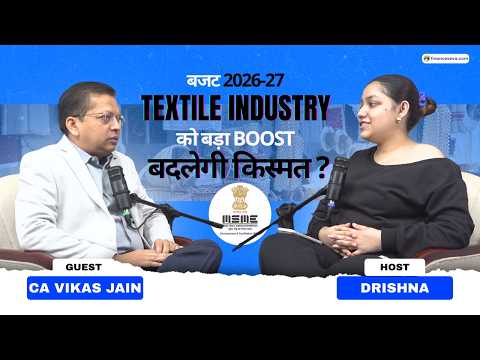
India ka textile sector — jo duniya ke sabse bade employment generators me se ek hai — har saal Union Budget se badi expectations rakhta hai. Textile industry ka major contribution GDP, exports aur MSME sector me hai.
Union Budget 2026 me textile sector ke liye likely focus areas ho sakte hain:
PLI Scheme Expansion
Technical Textiles Boost
Export Incentives
MSME Support & Credit Access
Infrastructure & Mega Textile Parks
Duty Rationalisation
Budget present kiya jaata hai Finance Minister dwara, aur textile policies ka implementation Ministry of Textiles ke through hota hai.
Union Budget India ka annual financial statement hota hai jo Government of India Parliament me present karti hai — isme revenue, expenditure, taxation, subsidies aur sector-specific announcements hote hain.
Budget constitutional requirement hai aur Government of India dwara present hota hai.
India world’s largest cotton producer
4.5+ crore direct & indirect employment
Major export contributor
MSME dominated sector
Growing demand in technical textiles & man-made fibres
Textile policy implementation primarily Ministry of Textiles ke under hoti hai.
Budget approval process Parliament me hota hai jisme Parliament of India ka role hota hai.
High value MMF & Technical Textile products ko promote karne ke liye incentive support.
Infrastructure support & cluster-based development.
RoDTEP rate enhancement & global competitiveness.
Modern machinery purchase par capital subsidy.
Lower interest loans, credit guarantee expansion.
Medical textile, defense textile, geo-textile promotion.
| Basis | Merits (Fayde) | Demerits (Challenges) |
|---|---|---|
| Employment | Job creation increase | Skill gap issue |
| Export Growth | Forex earnings boost | Global demand uncertainty |
| Infrastructure | Mega parks improve logistics | Implementation delays |
| MSME Support | Affordable credit access | Compliance burden |
| Technology | Modernisation support | High capital investment required |
| Global Competitiveness | Better positioning in global market | Policy dependency risk |
Export competitiveness improvement
Lower production cost
Infrastructure development
Access to formal finance
Increased FDI attraction
Supply chain integration
Boost to Technical Textiles
Textile schemes me eligibility typically:
Registered company / LLP / Partnership
GST Registration
PAN
Udyam Registration (for MSME)
Investment threshold criteria meet kare
Sector-specific product category eligibility
Company Incorporation Certificate
PAN & GST
Udyam Registration
Project Report
Financial Statements
Bank Details
Machinery Invoices
Land/Lease Documents (if applicable)
Export documents (if export-linked incentive)
“Make in India” boost
Rural employment growth
Women workforce participation
Textile exports target increase
China+1 strategy advantage
Kyuki taxation, subsidies aur export incentives yahi decide hote hain.
Production par incentive dekar global competitiveness badhati hai.
Haan, credit support aur subsidy schemes available hoti hain.
Special purpose fabrics jaise medical, industrial, defense use ke textiles.
Integrated mega textile manufacturing clusters.
Government competitiveness badhane ke liye duty rationalisation kar sakti hai.
Modern technology aur capital inflow me help karta hai.
Haan, textile stocks par positive/negative reaction aa sakta hai.
Eligible MSMEs ko interest subvention mil sakta hai.
Infrastructure + Export incentive + PLI expansion ka combined impact.
CA Vikas Jain - Our Mentor

 9863-02-02-02